

Chart Users Guide: A Comprehensive Overview (Updated 02/27/2026)
This guide, updated today – 02/27/2026 – offers a deep dive into chart creation, particularly within Excel. Simon Sez IT’s resource empowers users to effectively visualize and interpret data.
What is a Chart and Why Use Them?
Charts, also known as graphs, are visual representations of data. They transform numbers and text into easily digestible images, revealing patterns, trends, and relationships that might be obscured in raw data. But why bother with charts when you have spreadsheets full of numbers? The answer lies in human perception.
Our brains are remarkably efficient at processing visual information. A well-designed chart can convey complex data insights far more quickly and effectively than a table of figures. This is crucial for communication – whether you’re presenting findings to colleagues, stakeholders, or the public.
Charts aren’t just about making data look pretty; they’re about understanding it. They help identify outliers, compare different datasets, and forecast future trends. Effective visualization allows for quicker, more informed decision-making. From simple bar graphs to complex scatter plots, the right chart type can unlock hidden stories within your data, making it a powerful tool for analysis and presentation. Ultimately, charts bridge the gap between data and understanding.
Types of Charts: A Broad Categorization
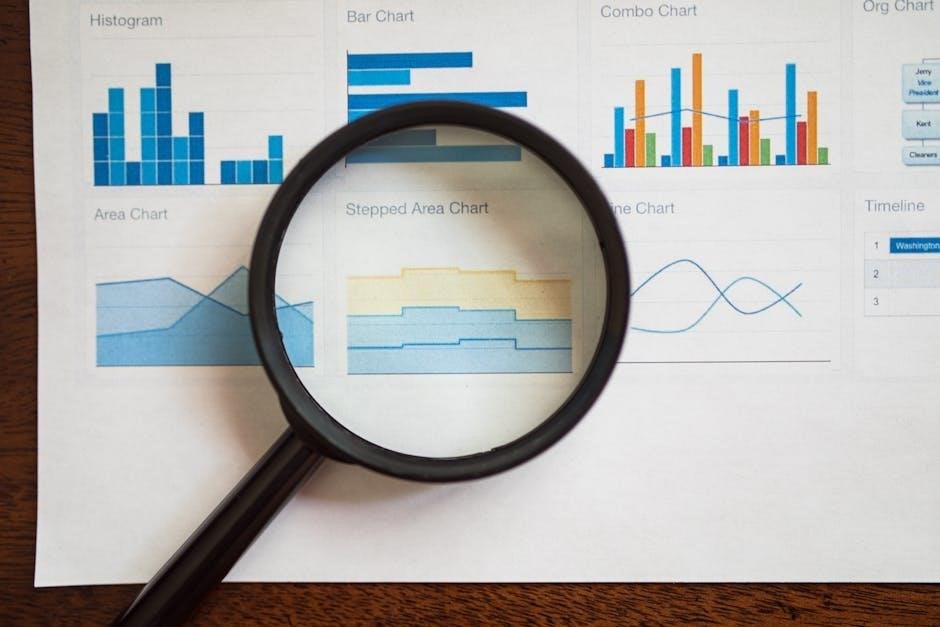
Charts fall into several broad categories, each suited for different types of data and analytical goals. Comparison charts – like column, bar, and radar charts – excel at showcasing differences between data points. These are ideal for highlighting which category performs best or comparing values across groups.
Relationship charts, including scatter plots and bubble charts, reveal correlations and connections between variables. They help determine if two datasets are linked and the strength of that relationship. Distribution charts, such as histograms and box plots, illustrate the frequency and spread of data, revealing patterns and outliers.
Composition charts – pie charts and stacked bar charts – demonstrate parts of a whole, showing proportions and percentages. Finally, trend charts, like line charts and area charts, track changes over time, revealing patterns and forecasting future values. Selecting the appropriate category, and then the specific chart type within that category, is vital for clear and accurate data representation.
Column Charts: Understanding and Application
Column charts, a staple of data visualization, use vertical bars to represent data values. They are exceptionally effective for comparing discrete categories of data, making it easy to quickly identify the highest and lowest values. Simple column charts display data for a single metric across different categories, while clustered column charts compare multiple metrics within each category.
Stacked column charts show the composition of each category, displaying the contribution of different components to the total. 100% stacked column charts normalize the data, showing the percentage each component contributes. When constructing column charts, ensure clear labeling of axes and categories.
Avoid overcrowding the chart with too many categories, as this can hinder readability. Consider using a consistent color scheme and appropriate spacing between columns. Column charts are best suited for data with a limited number of categories and when the focus is on comparing absolute values. They are a powerful tool for presenting straightforward comparisons.
Bar Charts: Horizontal Comparisons
Bar charts offer a compelling alternative to column charts, presenting data with horizontal bars instead of vertical ones. This orientation is particularly useful when dealing with lengthy category labels, as they have ample space for clear display without rotation or truncation. Like column charts, bar charts excel at comparing discrete categories, allowing for quick identification of maximum and minimum values.
Variations include grouped/clustered bar charts, which compare multiple data series side-by-side for each category, and stacked bar charts, which illustrate the composition of each category by displaying contributing parts. 100% stacked bar charts showcase percentages.
Effective bar chart design prioritizes clear axis labeling and a logical ordering of categories – often alphabetical or by value. Avoid excessive colors or visual clutter. Bar charts are ideal when category names are long or when emphasizing the magnitude of differences between categories is crucial. They provide a visually accessible way to present comparative data.
Line Charts: Tracking Trends Over Time

Line charts are the go-to visualization for displaying trends and changes in data over a continuous period, typically time. They connect data points with lines, making it easy to observe patterns, fluctuations, and overall direction. This chart type is exceptionally effective for showcasing data that has a temporal relationship, such as stock prices, temperature readings, or sales figures over months or years.
Multiple lines on a single chart allow for comparison of different datasets over the same timeframe. However, avoid overcrowding the chart with too many lines, as it can lead to visual confusion. Consider using different line styles and colors to differentiate between series.
Key considerations for effective line charts include clearly labeled axes, appropriate scaling, and the use of markers to highlight specific data points. Line charts are powerful tools for identifying trends, making predictions, and communicating changes over time, offering a clear and concise visual narrative.

Pie Charts: Showing Proportions and Percentages
Pie charts excel at illustrating parts of a whole, displaying data as slices of a circular pie. Each slice’s size is proportional to the percentage it represents, making it easy to quickly grasp relative contributions. They are best suited for datasets with a limited number of categories – typically five or fewer – to maintain clarity.
Effective pie charts require clear labeling of each slice with its corresponding category and percentage. Avoid using pie charts to compare the sizes of slices that are very similar, as it can be difficult to visually discern small differences. Consider using a bar chart instead for precise comparisons.
3D pie charts are generally discouraged as they can distort the perception of slice sizes. Focus on simplicity and clarity to ensure your audience can easily understand the proportions being represented. Pie charts are a visually intuitive way to showcase part-to-whole relationships, but their effectiveness hinges on thoughtful design.
Scatter Plots: Identifying Correlations
Scatter plots are powerful tools for visualizing the relationship between two different variables. Each point on the plot represents a single observation, with its position determined by its values for both variables; Unlike charts showing totals, scatter plots focus on individual data points and their distribution.
The primary purpose of a scatter plot is to identify correlations – whether a positive, negative, or no correlation exists between the variables. A positive correlation indicates that as one variable increases, the other tends to increase as well. A negative correlation suggests an inverse relationship.
Look for patterns in the distribution of points to assess the strength and direction of the correlation. Be cautious about assuming causation based solely on correlation; other factors may be at play. Adding a trendline can help visualize the overall relationship and provide a mathematical representation of the correlation. Scatter plots are invaluable for exploratory data analysis.
Area Charts: Emphasizing Magnitude of Change

Area charts are variations of line charts, but with the area beneath the lines filled with color. This filling visually emphasizes the magnitude of change over time, making them particularly effective for showcasing cumulative totals or contributions of different components to a whole.

Stacked area charts display multiple data series on top of each other, illustrating how each series contributes to the overall total. However, be mindful of readability; it can be challenging to accurately compare the values of series that aren’t at the bottom of the stack.
Consider using a 100% stacked area chart to show the percentage contribution of each series, rather than absolute values. Transparency can be crucial to avoid obscuring underlying data. Area charts are best suited for datasets with relatively few series and a clear focus on demonstrating change over a continuous period.
Choosing the Right Chart Type for Your Data
Selecting the appropriate chart type is paramount for effective data visualization. The goal is to clearly and accurately communicate insights, and a mismatched chart can obscure rather than illuminate your data. Consider the story you want to tell.

For comparisons, column or bar charts excel. To show trends over time, line charts are ideal. Proportions are best displayed with pie charts, though avoid using them for numerous categories. Relationships between variables are revealed through scatter plots.
Think about your audience and their familiarity with different chart types. Simplicity is often key; avoid overly complex charts that require significant interpretation. Experiment with different options to see which best highlights the key takeaways from your data. A well-chosen chart transforms data into actionable knowledge.
Data Preparation for Charting
Before creating any chart, meticulous data preparation is crucial. Raw data rarely translates directly into a compelling visualization. Cleanliness and organization are paramount; errors or inconsistencies can lead to misleading charts and flawed conclusions.
Begin by identifying and handling missing values. Decide whether to exclude them, impute them, or acknowledge their presence. Ensure data types are correct – numbers should be formatted as numbers, dates as dates, and so on. Remove duplicates and correct any obvious errors.
Consider data transformation. You might need to calculate percentages, averages, or other derived values. Structuring your data in a tabular format (rows and columns) is generally best for charting software. Proper preparation saves time and ensures the accuracy and reliability of your visualizations.
Chart Elements: Titles, Labels, and Legends
Effective charts rely on clear and informative elements. A descriptive chart title immediately conveys the chart’s purpose and subject matter. It should be concise yet comprehensive, avoiding ambiguity. Axis labels are equally vital, clearly identifying the variables represented on each axis – including units of measurement.
Data labels directly display values on the chart, enhancing readability, especially for precise comparisons. However, avoid cluttering the chart with excessive labels. A legend is essential when multiple data series are present, associating colors or patterns with specific categories.
Strategic placement of these elements is key. Titles are typically positioned above the chart, while legends can be placed to the side or below. Ensure all text is legible, using appropriate font sizes and styles. These elements transform a collection of data points into a meaningful story.

Axis Formatting: Scaling and Labels
Proper axis formatting is crucial for accurate data representation. Begin with scaling – determining the minimum and maximum values displayed on each axis. Auto-scaling is convenient, but manual adjustments may be necessary to highlight specific data ranges or prevent misleading visualizations.
Consider the data’s nature when choosing a scale. Linear scales are suitable for evenly distributed data, while logarithmic scales are better for data with exponential growth. Axis labels should clearly indicate the variable being measured and its units. Avoid overlapping labels by adjusting font size or using abbreviations.
Tick marks represent specific values along the axis, aiding in precise reading. Customize their frequency and appearance for clarity. Number formatting (e.g., decimals, currency) ensures consistency and readability. Thoughtful axis formatting enhances data interpretation and prevents misrepresentation.
Color and Design Best Practices
Effective chart design hinges on thoughtful color choices and overall aesthetics. Utilize color strategically to highlight key data points and establish visual hierarchy. Avoid excessive colors, which can overwhelm the viewer. Opt for a limited palette of complementary colors that are visually appealing and accessible.
Consider colorblindness when selecting colors; tools are available to simulate how charts appear to individuals with different types of color vision deficiency. Backgrounds should be clean and uncluttered, avoiding patterns that distract from the data. Font choices should prioritize readability; sans-serif fonts are generally preferred for charts.
Maintain consistency in design elements across multiple charts within a report. Whitespace (negative space) improves visual clarity and prevents a cramped appearance. A well-designed chart is not only informative but also aesthetically pleasing, enhancing data comprehension and engagement.
Adding Trendlines and Error Bars
Trendlines visually represent the direction of data, revealing underlying patterns and predicting future values. Most charting software, like Excel, offers various trendline types – linear, exponential, logarithmic, polynomial, and moving average – each suited to different datasets. Selecting the appropriate trendline requires understanding the relationship within your data.

Error bars indicate the degree of uncertainty in your data points. They represent the variability or margin of error, providing a visual indication of data reliability. Common error bar types include standard deviation, standard error, and percentage.
Properly implemented, trendlines and error bars enhance data interpretation. They allow viewers to quickly grasp key trends and assess the significance of observed differences. However, avoid overusing them; ensure they genuinely add value and don’t obscure the underlying data. Always clearly label trendlines and error bars for clarity.
Data Tables in Charts: Displaying Underlying Values
Integrating data tables directly within your charts provides viewers with immediate access to the precise numerical values driving the visualization. This enhances transparency and allows for deeper analysis beyond the graphical representation. Most charting programs offer options to display data tables below, above, or alongside the chart itself.
Data tables are particularly useful when presenting complex datasets or when precise values are critical for decision-making. They eliminate the need for viewers to manually extract data from the chart, reducing potential errors and saving time.
Consider formatting the data table for readability, using clear column headers and appropriate number formatting. However, avoid overwhelming the chart with excessive detail. A well-designed data table complements the chart without distracting from its primary message. Ensure the table’s data aligns perfectly with the chart’s visual elements.
Dynamic Charts: Connecting to Data Sources
Dynamic charts represent a significant advancement in data visualization, moving beyond static representations to charts that automatically update when the underlying data changes. This is achieved by directly connecting the chart to a live data source – a spreadsheet, database, or even a real-time data feed.
The benefits are substantial: eliminating manual updates, ensuring data accuracy, and enabling real-time monitoring of trends. When the source data is modified, the chart instantly reflects those changes, providing an always-current view of the information.
Most modern charting software supports connections to various data sources. Establishing this link typically involves specifying the data range or query. Consider the implications of automatic updates – ensure the data source is reliable and the chart is designed to handle potential fluctuations. Properly configured dynamic charts are invaluable for dashboards and reports requiring up-to-the-minute insights.
Chart Customization Options (Excel Specific)
Excel provides a remarkably extensive suite of customization options, allowing users to tailor charts to precise specifications. Beyond basic formatting like colors and fonts, Excel enables granular control over chart elements.
Key areas for customization include: chart titles and subtitles, data labels (position, format, and content), legend placement and appearance, and axis scaling and formatting. You can adjust axis minimum and maximum values, number formats, and add custom tick marks.
Excel’s “Format” pane offers detailed control over individual chart elements. Explore options for adding chart rules, data bars, and icon sets for visual emphasis. Furthermore, Excel allows for custom error bar styles and trendline options (linear, exponential, logarithmic, etc.). Mastering these features transforms standard charts into compelling visual narratives, enhancing data comprehension and presentation quality.

Interactive Charts: Drill-Down and Filtering
Modern charting tools, including Excel, increasingly offer interactive features that elevate data exploration. Drill-down capabilities allow users to click on chart elements – such as a segment in a pie chart or a column in a bar chart – to reveal more detailed underlying data.
Filtering options empower users to dynamically focus on specific subsets of the data. This can be achieved through slicers connected to the chart, or directly within the chart itself using interactive legends or data point selection. These features enable a non-linear exploration of data, moving beyond static visualizations.
Interactive charts are particularly valuable in dashboards and reports where users need to investigate data independently. By enabling users to explore data at their own pace, these charts foster deeper insights and more informed decision-making. Excel’s Power BI integration further expands these interactive charting possibilities.
Common Charting Mistakes to Avoid
Creating effective charts requires more than just selecting a chart type and inputting data. Several common mistakes can obscure insights and mislead viewers. Over-cluttering charts with too much data, excessive gridlines, or distracting colors is a frequent error. Simplicity and clarity are paramount.
Incorrectly scaling axes can distort the visual representation of data, exaggerating or minimizing differences. Always ensure the y-axis starts at zero unless there’s a compelling reason not to, and clearly label axis increments. Misleading chart types – for example, using a pie chart for data that doesn’t represent parts of a whole – can also be problematic.
Failing to provide clear titles and labels leaves viewers guessing about the chart’s purpose and the data being presented. Always prioritize accurate and honest data representation; manipulating charts to support a pre-conceived narrative undermines trust and credibility. Careful review and thoughtful design are crucial.